Imagine two B2B software companies going after the same customer: a mid-market logistics company reviewing its freight management platform.
Both use AI to research the account. Both use it to write personalized outreach. Both can produce more content, faster and more cheaply, than they could three years ago.
Here's what lands in the VP of Operations' inbox.
Company A writes: "I noticed your company is focused on digital transformation. Our AI-powered platform helps logistics leaders drive efficiency and innovation."
Company B writes: "In a recent interview, your COO mentioned that freight claims in your Midwest network have been rising. In our experience, for regional carriers, most claims trace back to three handoff points. Here's a two-page breakdown of where they happen and what tends to fix them."
Both emails were written with AI. Both are technically personalized. Only one tells the buyer something she didn't already know.
Company B gets the meeting. Over time, it's the one that gets shortlisted, earns the buyer's confidence and wins at better margins. Company A produces more content, runs more campaigns and struggles to stand out.
If both have access to the same technology, what explains the difference?
For years, marketing advantage came from capabilities: better analytics, more sophisticated automation, personalization at scale. Those took budget, specialist teams and time to build, which kept them out of reach for many competitors. AI in marketing is collapsing that gap.
I think this raises one of the most important questions for marketing leaders right now: when everyone can execute, what still sets us apart?
Here are five things I think will matter more as AI becomes standard. AI can amplify each of them. It can't create any of them on its own.
1. Access to AI will matter less than what we do with it
AI is levelling the playing field. Smaller teams can do more. Experimentation costs less. Capabilities that once needed a large budget are available to almost anyone.
But it also creates a problem.
If every competitor can generate content at scale, volume stops being a differentiator.
If everyone can personalize outreach, personalization alone won't make us memorable.
If everyone can analyze public information, a competitor analysis is no longer an edge.
This doesn't mean AI stops making a difference. Companies with proprietary data, strong talent or better implementation may keep a real advantage. But for most marketing teams, access to the tools will matter far less than the choices we make with them.
The question is no longer whether we're using AI. It's what we can do with it that competitors can't easily copy.
2. AI amplifies the quality of our thinking
Consider two technology services companies using AI to shape their go-to-market strategy.
The first has a broad proposition: it helps enterprises "accelerate digital transformation through technology, engineering and innovation." Its AI tools analyze market trends, suggest target accounts, generate campaign ideas and produce content.
The second has made choices. It focuses on a specific segment, has a clear point of view on the problems those customers face and can explain why its approach leads to a different outcome. It uses AI to track account-level signals and build specific, evidence-based engagement.
Both are using AI. Both may be equally skilled with the technology.
But the second company has given AI a better problem to solve.
AI can analyze a market, but we still have to decide which opportunities matter. It can generate positioning options, but more options don't create differentiation. It can recommend target accounts, but we still have to decide where we have a credible right to win.
AI can accelerate our thinking. It can't replace strategic direction.
3. Differentiation matters more when everyone can execute faster
B2B buyers already wade through a steady stream of messages promising innovation, transformation and efficiency. AI makes generic messaging easier to reproduce at scale. If we haven't worked out what makes us different, AI may simply help us communicate our lack of differentiation more efficiently.
This is where positioning earns its keep. A strong position tells us which customers matter most, which problems we want to be known for and which proof points deserve the spotlight. AI can then help express that position in account-specific, relevant ways.
But AI can't create a credible position by generating compelling language. The position has to rest on something real, and the organization has to deliver on it.
4. The next advantage is how quickly we learn
Marketing has always generated signals. Customer conversations reveal shifting priorities. Lost deals expose gaps. Sales hears new objections every week. The problem is that these signals are scattered across systems and teams, and they can take months to change anything.
Here's how that plays out in two hypothetical cybersecurity software companies.
Both use AI to analyze sales call transcripts and lost-deal notes. Both spot the same pattern: mid-market buyers keep saying they don't have the in-house staff to manage another security tool.
At Company A, the insight lands in a quarterly report. Marketing reads it a month later. Updating the messaging needs three rounds of approval. Sales hears about it at the next quarterly business review. By the time anything changes, two quarters have passed.
At Company B, the same insight is flagged within a week. Marketing drafts a proof point around "runs without a dedicated security team" and a short customer story to back it up. Sales tests the new talk track in its next ten calls. Product looks at whether a managed onboarding option would help. Within a month, they know whether it's working.
Same insight. Same AI. Very different results.
The advantage isn't that AI made the research faster. It's that Company B was designed to act on what it learned.
5. Advantage comes from the combination, not a single capability
It's tempting to look for one defining source of advantage: proprietary data, better models, stronger talent. Each can matter. None guarantees success on its own.
A company can have rich customer data and no differentiated proposition. It can have a compelling position and struggle to deliver it consistently. It can generate great insights and lack the ability to act on them.
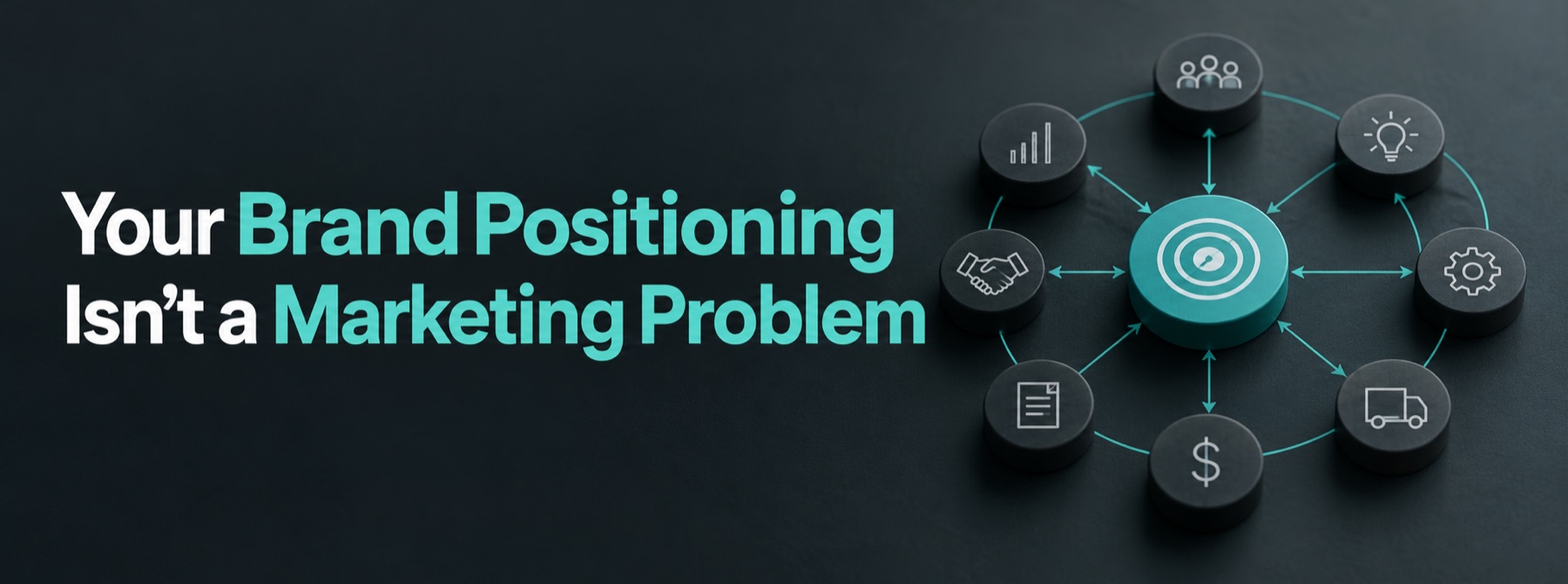
The advantage comes from how these pieces reinforce each other. Customer understanding shapes positioning. Positioning guides go-to-market decisions. AI turns those decisions into relevant execution at scale. Customer interactions generate new signals, and the organization learns and adapts.
AI can strengthen the advantages we already have. It can also expose the ones we don't.
So what should marketing leaders do differently?
I'd start with four questions.
1. What advantage do we want AI to amplify?
Before evaluating use cases, be clear about where you intend to win: customer understanding, domain expertise, a distinctive proposition or speed of response. Without that clarity, AI initiatives tend to become a collection of disconnected productivity experiments.
2. Are we measuring output or impact?
More content and lower production costs are useful operational measures. They aren't measures of advantage. The better question is whether AI is helping us reach more relevant buyers, sharpen our proposition and win more of the right business.
3. Does our operating model connect insight to action?
If information is fragmented and decisions are slow, more AI may speed up individual tasks without improving the overall system.
4. What are we building that competitors can't easily copy?
Accumulated customer knowledge, distinctive expertise, a trusted brand, an operating model that learns quickly. These take time to build. AI can make them more valuable by helping us use them at greater scale.
AI is changing the economics of marketing. It doesn't remove the need for differentiation. It makes it more important to understand where differentiation actually comes from.