Here's a pattern I've seen across marketing teams over the last two years.
- AI for copy.
- AI for images.
- AI for SEO.
- AI for social posts.
- AI for reporting.
And the same eight-week campaign approval cycle.
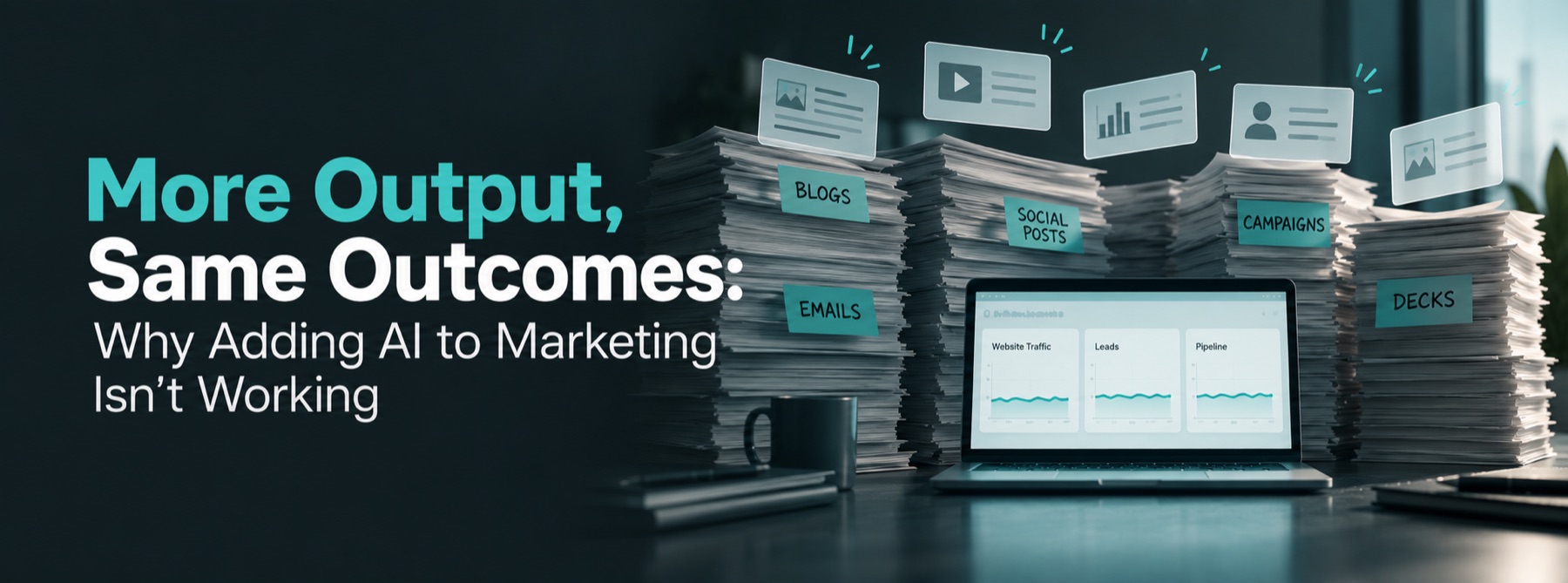
We're producing more content than ever. Drafts that took days now take minutes. Dashboards update themselves. And yet, for many teams, the numbers that matter most look much the same. Pipeline. Win rates. Sales cycle length. Customer acquisition cost.
The approach makes sense on paper. Adding AI to the work we already do is low risk. It produces quick wins, it's easy to explain to the board, and nobody has to redesign an org chart. Find a task, add a tool, save some time. Repeat.
But I think this is one of the most important mistakes we're making with AI in marketing right now. We're treating a change in how work can be done as a change in which tools we use.
And we've been here before.
In the late 19th century, factories began replacing steam engines with electric motors. You might expect productivity to jump. For decades, it didn't.
The reason, as economic historian Paul David described in a well-known 1990 paper, was design. Steam-era factories were built around one huge engine driving a central shaft, with belts and pulleys carrying power to every machine. When factories first electrified, many simply swapped the big steam engine for a big electric motor. Same shaft, same layout, same way of working.
Productivity in US manufacturing only surged in the 1920s, roughly three decades after electric motors first appeared on factory floors.
What changed? Factories were redesigned around what electricity made possible. Instead of one large engine, dozens of small motors powered individual machines. Buildings were laid out around the flow of work rather than the position of a driveshaft.
The technology arrived long before the gains. The gains came when the work was redesigned.
That is where most of us are with AI in marketing. We've swapped the steam engine for an electric motor. We haven't moved the walls.
More output isn't the same as better outcomes
There's a useful distinction here between outputs and outcomes.
Outputs are the things we produce: blogs, emails, campaigns, ads, reports. Outcomes are what changes as a result. That might be a buyer adding us to a shortlist, a champion building an internal business case, or a customer expanding into a new division.
AI is extraordinarily good at outputs. That's exactly why it's so easy to mistake activity for progress.
Consider two companies that both introduce AI into marketing.
Company A uses it to go from four blogs a month to twenty, and from three email variants per campaign to thirty. Output is up dramatically.
Company B uses it to monitor which target accounts are showing buying signals, and to build a tailored brief for the sales team on each one: what the account cares about, which proof points fit and what to say first. It produces fewer assets, not more.
Both companies are using AI. Only Company B has changed an outcome: better-informed first conversations with the right buyers at the right time.
There's a second problem with chasing output. When content becomes cheap to produce, buyers get more of it, from everyone. Their attention doesn't grow with our output. So more output can easily mean less impact per piece.
The bottleneck moves, but the organization doesn't
When we add AI to one step of a process, the constraint rarely disappears. It just moves.
Here's how that tends to play out.
A marketing team introduces generative AI for content. Drafts that took three days now take three hours.
Content volume triples.
But every piece still goes through the same review process: a brand manager, a product expert, sometimes legal. The same three people now have three times as much to review.
The review queue grows. Turnaround slows. Reviewers start skimming.
Quality becomes inconsistent, and some of the best work sits in the queue while the moment passes.
The bottleneck has moved from creating content to approving it. Nothing in the system was designed for that.
Individually, nobody is doing anything wrong. The content team is using the tools it was given. The reviewers are protecting the brand. The problem is that we changed one part of the system and left the rest exactly as it was.
We measure what AI saves, not what it changes
The way we measure AI adoption often reinforces the problem.
Hours saved. Assets produced. Tool adoption rates. Cost per piece of content.
These are all output measures. They tell us AI is being used. They don't tell us whether marketing is working any better.
So instead of reporting "AI saved our team 400 hours this quarter," try asking what those hours made possible. For example: "We cut the time from a buying signal to a first sales conversation from three weeks to four days." The specific measure will vary by business. What matters is that it describes a change in what buyers or sellers do, not just in what we produce.
Designing marketing around AI
There's a broader lesson here for marketing leaders.
We've spent the last two years asking where AI fits into the work we already do. That was a reasonable place to start. But it keeps us inside the shape of a marketing function that was designed for a world without AI: its handoffs, its approval chains, its campaign calendars and its measures of success.
It shifts the question from:
Where can we add AI to what we already do?
to:
If we were designing marketing from scratch today, knowing what AI can do, what would we build?
That is a much harder question. It's also the one that leads to real change, and it's where I'll pick up in the next part of this series.
Because the value of AI in marketing isn't achieved simply by producing more.
It's achieved when we redesign how marketing creates outcomes.
Sources: Paul A. David, "The Dynamo and the Computer: An Historical Perspective on the Modern Productivity Paradox," American Economic Review (1990); Tim Harford, "What we get wrong about technology" (2017); Josh Seiden, Outcomes Over Output (2019).